Noord-Brabant in het spoor van Limburg?
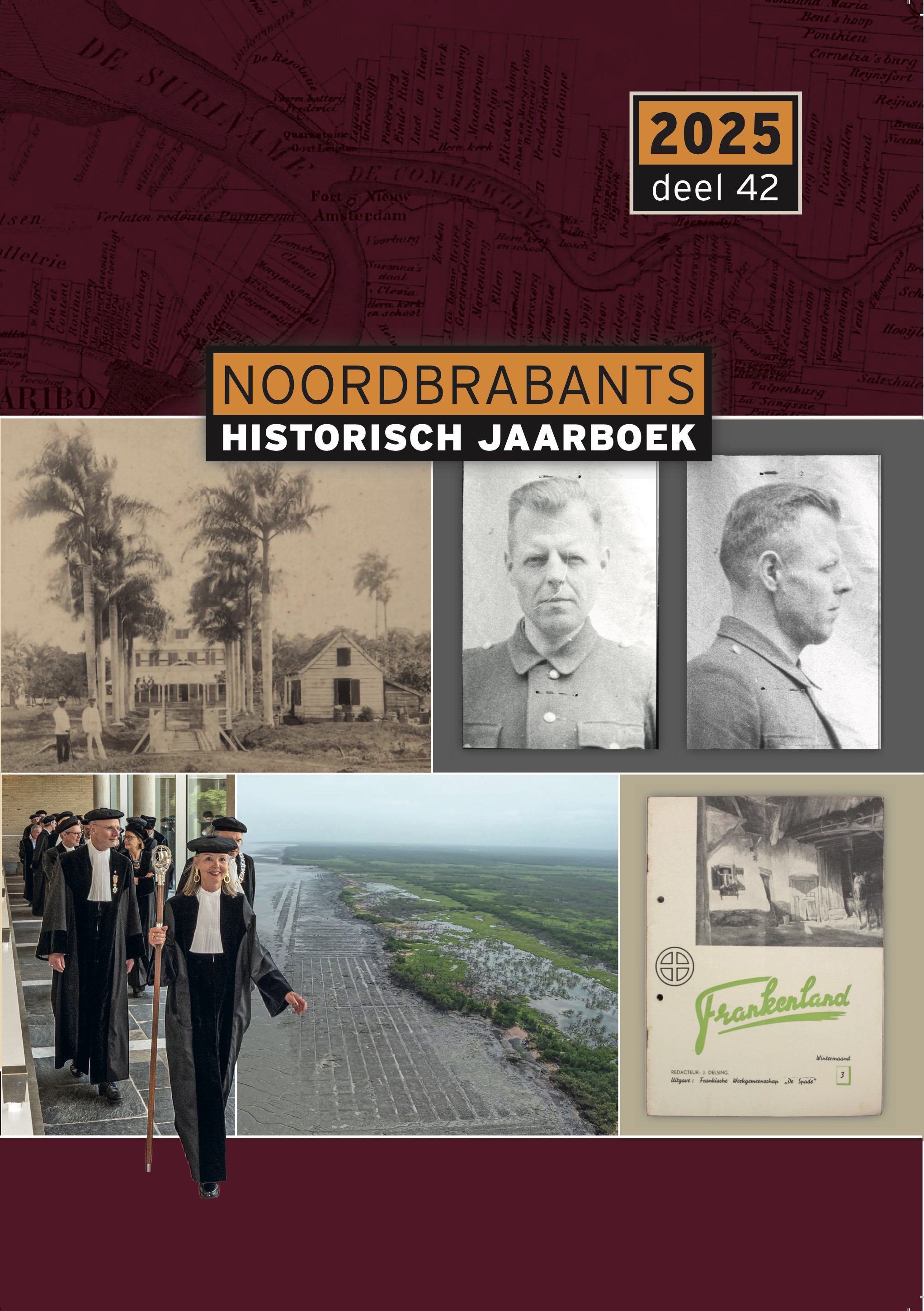
Het collaborerende heemkundige tijdschrift Frankenland (1943-1944)
DOI:
https://doi.org/10.71265/x2e0g911Samenvatting
Het nationaalsocialistische volkskundige en heemkundige tijdschrift Frankenland verscheen in de jaren 1943-1944 en bestreek het Zuiden van Nederland. Het was een initiatief van heemkundigen die op Duitsland georiënteerd waren, van wie de meesten uit Limburg kwamen en enkelen uit Noord-Brabant. In de eerste nummers van Frankenland was de focus dan ook vooral op Limburg gericht, in latere nummers veranderde dit. In het blad werd de nationaalsocialistische geografische fictie gepropageerd van het Zuiden als een samengesmeed Frankenland waarin Limburg en Noord-Brabant bij elkaar zouden horen. Werkelijk succesvol kon dit idee echter niet zijn in Noord-Brabant, waar sommigen meer zagen in de Groot-Nederlandse gedachte, waarin Nederland en Vlaanderen als historische eenheid worden gezien. Men richtte in Noord-Brabant eerder de blik over de zuidgrens dan over de oostgrens.
In de nationaalsocialistische visie waren de Franken een Germaans volk, net als de Saksen en de Friezen. Deze drie volkeren zouden samen het latere Nederland hebben bewoond. Nationaalsocialistische heem- en volkskundigen bouwden hiermee voort op denkbeelden die in Nederland al voor de oorlog (en trouwens ook erna) wijdverbreid waren, ook buiten nationaalsocialistische kringen. Hiermee maakten zij het Zuiden onderdeel van een op raciale denkbeelden van etnische ‘stamverwantschap’ gebaseerde ideologie.
Sommige nationaalsocialisten zagen de inwoners van Noord-Brabant en Limburg echter als niet puur Germaans of zelfs als raciaal inferieur, maar dit komt niet naar voren in het tijdschrift Frankenland, waarin bovendien rechtstreekse verwijzingen naar de Duitse bezetting vrijwel ontbreken. Wel zette het blad zich af tegen Holland en propageerde het de Blut und Boden-ideologie van de nationaalsocialisten. Volkskunde en heemkunde werden zo een middel om de nationaalsocialistische visie op het verleden en heden te verspreiden en zo fungeerde het tijdschrift ook. Zodoende was het blad een cultureel-politiek instrument dat het vermeende Germaanse stamverband beklemtoonde ten koste van een historisch correcter beeld van de culturele en politieke ontwikkeling van Noord-Brabant en Limburg.
North Brabant following in Limburg's footsteps?
The collaborationist local history magazine Frankenland (1943-1944)
The National Socialist folklore and local history magazine Frankenland was published in 1943-1944 and covered the southern part of the Netherlands. It was an initiative of local historians who were oriented towards Germany, most of whom came from Limburg and a few from North Brabant. The first issues of Frankenland therefore focused mainly on Limburg, but this changed in later issues. The magazine propagated the National Socialist geographical fiction of the South as a forged Frankenland in which Limburg and North Brabant belonged together. However, this idea could not really succeed in North Brabant, where some people were more interested in the Greater Netherlands idea, in which the Netherlands and Flanders are seen as a historical unit. In North Brabant, people tended to look across the southern border rather than the eastern border.
In the National Socialist view, the Franks were a Germanic people, just like the Saxons and the Frisians. These three peoples were said to have inhabited what later became the Netherlands. National Socialist local historians and folklorists built on ideas that were already widespread in the Netherlands before the war (and indeed afterwards), even outside National Socialist circles. In doing so, they made the South part of an ideology based on racial ideas of ethnic kinship.
However, some National Socialists viewed the inhabitants of North Brabant and Limburg as not purely Germanic or even as racially inferior, but this is not reflected in the magazine Frankenland, which also contains virtually no direct references to the German occupation. The magazine did, however, oppose Holland and propagated the National Socialists' Blut und Boden ideology. Folklore and local history were thus instrumentalized for spreading the National Socialist view of the past and present, and the magazine functioned as such. It was therefore a cultural-political instrument that emphasized supposed Germanic tribal connections at the expense of a more historically accurate picture of the cultural and political development of North Brabant and Limburg.
Downloads
Downloads
Gepubliceerd
Nummer
Sectie
Licentie
Copyright (c) 2025 Olivier Rieter

Dit artikel is gelicentieerd onder de Naamsvermelding 4.0 Internationaal licentie.