Het spel van Teuku Umar
Laatnegentiende-eeuwse Nederlandse bordspelletjes als koloniaal discours
DOI:
https://doi.org/10.62513/m8e72474Keywords:
board games, colonialism, Dutch Empire, Indonesia, discourseAbstract
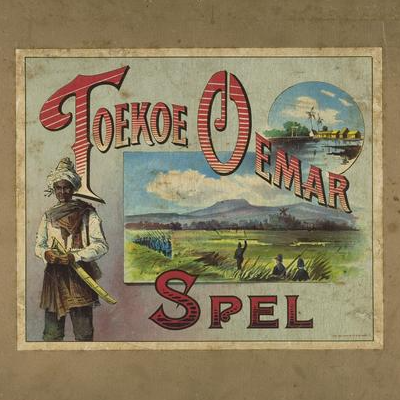
At the end of the nineteenth century, Dutch colonial policy was dominated by the war in Aceh, the northernmost region of the Indonesian island of Sumatra. One person who dominated Dutch newspapers was Teuku Umar (1854-1899), an influential Acehnese leader who initially sided with the Dutch rulers but ultimately chose the side of Aceh. In 1896, the year Teuku Umar switched sides to Aceh, the Amsterdam publishing and printing house Jos. Vias Dias & Co. released the Toekoe Oemar board game. The game consisted of 25 yellow discs representing white soldiers. There was one black (!) disc, Teuku Umar, which had to be trapped in one of the triangles on the geographical map or surrounded in the square. ‘When both parties follow the game with equal attention, the odds are equal,’ stated the instruction manual. Another game was Atchin. New Amusing Conquest Game. In this game, the kraton (palace/fortress) of Aceh had to be conquered, just as in reality in 1873-1874. What do these games tell us about the perception and role of the Aceh War and the person of Teuku Umar in Dutch and colonial society of that time?
Downloads
Downloads
Published
Issue
Section
License
Copyright (c) 2026 Caroline Drieënhuizen (Auteur)

This work is licensed under a Creative Commons Attribution 4.0 International License.